Showing posts with label Arran. Show all posts

Wednesday, 11 June 2014

Breeding Pheasant - Cute chicks


Whilst the breeding of the pheasant is closely controlled by David the Gamekeeper, mother nature shows us how it's really done and we have plenty of pheasant nesting in the scrub around the grounds. All very well camouflaged.
These seem to be doing quite well, with large clutches of eggs and we try to disturb them as little as possible. All of them, Estate reared or not will be well fed and mingle once they are grown.
Meanwhile the eggs are 'pippin' in large numbers in the hatchery as the little chicks fight their way out. The trays are no longer rocking and the bases are solid so the chicks can't fall through.
It's fascinating to watch as the chick cuts a circular hole around the top of the egg as it cuts it's own 'hatch' out. For linguists - verb 'hatch' as in life from an egg, noun 'hatch' as in doorway (often nautical).
Flipping the top back and emerging as an independent life. 
Looking a little grumpy before the feathers fluff up.  The temperature and humidity are still regulated to give it the best chance of survival before being taken into the 'nursery'.
Little chick being transported into the nursery.

Lots of mates to play with, and still temperature regulated.
Not long before they get moved to the outside pens.


Thursday, 1 May 2014

Breeding pheasant - the first egg!

Not broody - having a dust bath
Well it looks like the birds have done the business and now we are reaping the first eggs.  My only experience of this was a few years ago when I kept hens and a broody hen decided to defend her nest to the death!  In the interests of preserving my hands, I decided to let her be.  However, this is not what I am seeing in the pheasant aviaries. The eggs seem to be dotted around and none of the females seem overly broody.
Eggs ready for collecting
Most are have some dirt and ground debris attached and require washing with a special egg wash. And they have to be put into the trays 'pointy' end down.  Apparently to help prevent the yolk sac from sticking to the side.
Egg wash required
After cleaning they stand in the trays for about 10 days at an angle and are turned daily.  The temperature is regulated at 15c. Then they get put into a large incubator where the temperature is increased to about 37.5c and humidity maintained at 65% using ionized water (to prevent disease).
The incubator
The trays that the eggs sit on, rock every 2 hrs, again to stop the yolk sack setting on the edge of the eggs. The door remains firmly closed to maintain the correct conditions and is only opened when absolutely necessary, so I had to peer through the viewing hatch! However, they will be checked half way through to check that the eggs are fertile, by shining a light through the shell.
Viewing hatch into incubator.
After 21 days the eggs should start 'pipping', when the chick starts to crack the shell ready to hatch.  So I now have to be patient before we can move to the next stage.

Thursday, 27 March 2014

Breeding Pheasant - A mating game

Proud cock pheasant with his ladies
Pheasant are not a native bird to the UK and therefore the majority of birds seen around the countryside have been released at some time, albeit a few successfully breed in the wild.  A previous blog on pheasants was published back in May last year. Sporting Estates invest huge amounts of time and effort into their bird stocks and so it is with great interest I am going to follow the breeding season of a few pheasant on the Dougarie Estate.
Davy Anderson with a small pen
The Estate hasn't bred it's own birds for quite a number of years, but the new gamekeeper, David Anderson, has a lot of experience in this area and will be testing his skills over the next few months.
One of the main pens
Capturing the birds provided the first hurdle, and Davy set traps to capture both male and female (Cocks & Hens), before transporting them back to the ready made avaries on the estate.  One one return journey - he stopped outside the lodge and commented about the number of hens he had seen while driving back, before realising he hadn't closed the basket on the back of the quad!
Female (hen) pheasant 
Undeterred, sufficient birds are now being managed in purpose built avaries.  There is plenty of room, as the cocks will fight for the females, along with fresh water, food and shelter.  The same needs of any animal and if the accommodation / care isn't good enough the birds are unlikely to breed.  The pen is covered to prevent predators (mainly buzzards - there are no foxes on Arran) from having an easy meal.
The birds enjoying a bit of sunshine
Unlike hens, pheasant tend only to lay eggs in the breeding season between February & April. So now we are just waiting for the first egg!


Images copyright of Arran in Focus

Wednesday, 8 January 2014

The challenges of having a golf course by the sea!

The first tee under a foot of seaweed
The last 12 months have seen Machrie Bay Golf Course face many challenges all of which, David the Head Greenkeeper has taken in his stride.  The recent storms have yet again wreaked havoc, fortunately this time, limiting the damage to the first fairway.
A new water feature!
Although this cannot be compared with damage to peoples homes, the damage will take many months of hard work for David and his new apprentice Jamie to sort out. But first is the mammoth task of removing the debris of seaweed, sand, stone slabs and even large lumps of metal.  The snow shovels are well suited to the task and some of the seaweed has been ferried to gardens as it makes great fertiliser.
Large stones, chunks of concrete and sand on the fairway
Although the first tee may be out of action the course remains open and we have a very special offer available. Play golf, have soup and a toastie (or sandwich) and watch the clear up - all for £10.  The tearoom is usually open between 11am - 3pm (ish).
Snow shovels are perfect for lifting the seaweed.
There are plans to move the first tee to a more robust location in the future!
Large red metal tail gate is amongst the debris.
Images copyright of Arran in Focus

Friday, 20 December 2013

Machrie Bay Golf Course - A challenging year!

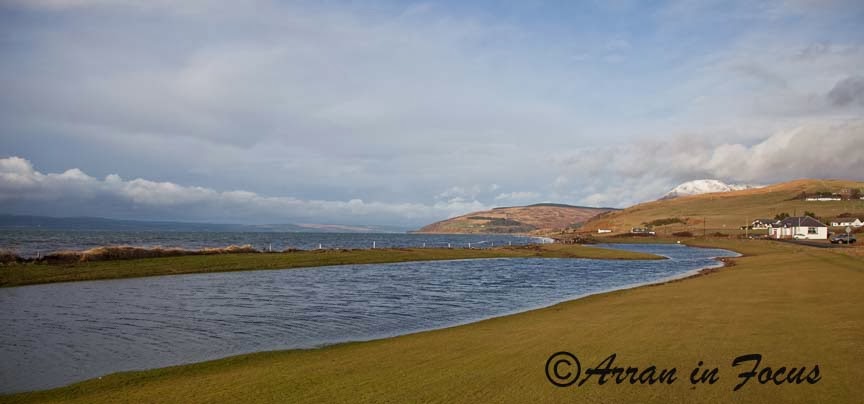
1st Fairway underwater - Dec 2013 (snow on hills in the background)
How the fairway should look!
It seems fitting to be very near the end of the year and Machrie Bay Golf course, part of Dougarie Estate, is in the forefront of our minds again. To say it has been a challenging year would be an understatement, most of the pressure being bourne by David the Greenkeeper. The year started with fire and ended in flood, with most other extreems inbetween!
1st fairway with sea & debris - Dec 2013
It has to be said that throughout the year David has done a tremedous job keeping the greens in fabulous condition despite having no greenkeepers sheds.  And he is currently mopping up after the latest storm which breached the sea wall and flooded the first tee, leaving behing piles of seaweed and debris.  Brodick Golf Course suffered a similar fate.  However visiting golfers should not be put off as we have 7 very varied courses on the island and a driving range.  Golf on Arran website has all the details.
The tearoom opens under new management with views across the fairway to the sea.
The snow melts slowly under blue skies - April 2013
Fortunately, the new shed is now up and running so tools are near to hand and the tearoom has stayed open for the winter, providing hot soup, sandwiches and huge mugs of tea (or even better steaming hot chocolate). After the snow earlier in the year the summer proved to be a scorcher and was a well needed break from the freak weather.
The snow arrived - March 2013
Experience has shown that the greens survive better if the snow is left undisturbed
Currently we have a special offer on for the quiet winter months where you can play a round of golf and get soup and a sandwich (or toatie) at the tearoom for £10.  


Greenkeepers shed burnt down - January 2013


Monday, 12 August 2013

Introducing David

Gamekeeper - David
David joined the Estate on the 1st July this year as our new gamekeeper after Alastair moved back to the mainland to take up a new post. Drew will continue to stay with us as the underkeeper whilst attending college during the year.

Alastair on a shoot last year
David has come from the Knockando Estate in Aberlour where he was the stalker / ghillie.  With over 20 years under his belt he is an experienced gamekeeper having run the pheasant shoots, stalking for both red and roe deer, along with fishing on the River Spey. At the same time as this he was responsible for the keepering at the Castle Grant shoots.

David has brought his own working dogs with him, a Labrador, spaniel and two pointers.  One is still very much a puppy that is still undergoing training and won't be out on shoots this year.
The castle like Towers

David has taken up residence at the Towers with his wife Jan and their 4 year old son, also called David. David will be attending Shiskine primary school when term starts and is enjoying living in a house that looks like a castle.  Jan has been helping with the estates holiday houses and is looking to meet new people on the island.  

Thursday, 20 June 2013

Garden Open Day - 29th June 2014


Herbaceous border
Once a year the public get a fabulous opportunity to view the private terraced gardens of Dougarie Lodge, situated on the West side of the Isle of Arran.  From easily recognisable flowers to exotic rare plants there is something for everyone dotted around the terraces in nooks and crannies.  There is even a small woodland area to explore at the side of the formal top lawned area and a traditional kitchen garden.
Lily 
Black Iris
The terraces are castellated and provide shelter for more delicate plants and allow for beautiful herbaceous borders. Each terrace has a lovely lawn and a different display.


Mrs Gibbs is a very keen horticulturalist and does most of the work herself only having a few hours of help each week to maintain this massive garden.
Grevilia
Wandering around it is easy to miss some of the smaller blooms between huge displays of colour which have been trained up the stone walls and cascade over stairways. The position of the gulf stream allows for some more exotic plants to grow in this unique climate.

Steps with flower cascades
A few seats are placed to take in the view which stretches across the lawns in front of the lodge down to the river Iorsa and beyond.
Clematis & Sphaeralcea 
Marigold 
The plants bloom at different times of the year so there is always something of interest to view, although June sees some of the best displays of flowers.

Seats in little nooks
During the open afternoon cream teas are served in the Boathouse, which is a listed building not usually open to the public, and there is a small plant stall.


The gardens are open through Scotlands Open Garden scheme, between 2pm – 5pm, Sunday 29th June.  Admission is £3.50 for adults and free for children.  Profits are divided between Pirnmill Village Association who receive 40% and the remainder goes to other beneficiaries.


Dicentra

Abutilon
 
Scabius
Aeorium
View down to the River Iorsa

 All photographs copyright of Arran in Focus